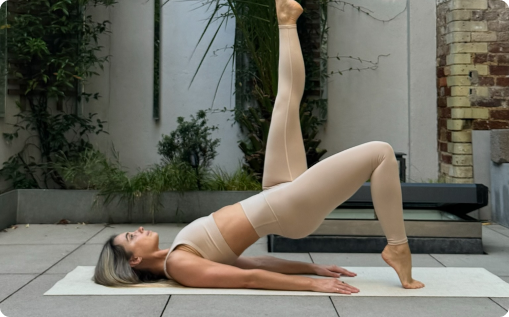
If you’ve been loving the Power Up Pilates Challenge and the addition of extra weights, you’re not alone. Adding extra resistance to your Pilates workouts isn't just fun – when done intentionally, it is one of the most effective ways to elevate your strength gains.
Let’s break down why resistance and Pilates pair so well in supporting a stronger, more resilient body.
Added Resistance Builds Lean Muscle
Traditional Pilates already uses your bodyweight as resistance, but external load adds a new stimulus for your muscles. When you introduce light resistance to your Pilates classes:
-
Muscle fibres are challenged to produce more force
-
Your body adapts by increasing muscular strength and endurance
-
You maintain the important Pilates focus on alignment and control
Research consistently shows that increasing resistance on your muscles is key for improving strength and muscle tone. Even small loads (think 0.5–2kg dumbbells, wrist or ankle weights) are enough to create meaningful change when performed with control and sufficient reps.
In Pilates, this means stronger muscles without sacrificing form.

Increased Muscle Activation = More Efficient Workouts
Adding resistance increases neuromuscular demand, which is the communication between your brain and muscles. Studies show that adding external resistance to exercises:
-
Increases muscle activation
-
Improves motor control
-
Encourages deeper stabilising muscles to switch on
This is especially powerful in Pilates, where we target your deep core muscles (transverse abdominis, pelvic floor, multifidus) rather than just superficial muscles.
In simple terms: your muscles work smarter, not harder. Your movements become more efficient and precise, maximising the benefits of each exercise.
Bone Health and Injury Prevention
Weightbearing and resistance-based exercise is essential for maintaining healthy bone density, particularly in women. Women are at a higher risk of osteopenia and osteoporosis – conditions where bones lose density and become more fragile – especially after menopause when oestrogen levels drop. Low impact resistance training:
-
Stimulates bone remodelling/strengthening
-
Helps slow age-related bone loss
-
Supports joint stability
Pilates with resistance offers a joint-friendly way to strengthen your body, making it ideal for those wanting to protect their bones and joints while still building strength.
Stronger muscles also mean better joint support, which can reduce injury risk in everyday movement and other forms of training.

Better Balance, Stability & Functional Strength
When you add resistance, your body must work harder to stabilise itself. This challenges:
-
Proprioception (your body’s awareness in space)
-
Balance and coordination
-
Postural muscles
Because Pilates movements mimic real-life patterns like reaching, lifting, carrying and rotating, resistance helps translate strength into functional movement.
This is the kind of strength that carries over into daily life (think picking up kids/pets, carrying groceries, generally moving with confidence) and will keep you youthful for longer!
More Results Without More Impact
One of the biggest benefits of adding weight to your Pilates workouts is that you don’t need to jump, run or lift heavy to notice change. Pilates with resistance allows you to:
-
Increase your strength work without increasing impact
-
Elevate heart rate subtly through muscular demand
-
Build lean muscle while staying low-impact
This makes it accessible, sustainable and incredibly effective, especially if you’re returning to exercise, managing injuries or wanting long-term consistency.

How We Use Resistance at Pilates By Bel
In Pilates By Bel workouts, resistance is always:
-
Optional – you’re encouraged to listen to your body and only add weight when you're up for a challenge
-
Layered – we build gradually, not all at once
-
Intentional – programmed to be results-driven without losing important focus on alignment and control in your body
The goal isn’t to make Pilates feel like a weights session. It’s to enhance your Pilates workouts and provide additional benefits for your total body strength and balance.

With the right load and mindful execution, resistance-based Pilates can:
-
Improve strength and muscle tone
-
Support bone and joint health
-
Enhance balance, stability and posture
-
Deliver efficient, functional strength results
If you’re ready to explore resistance-based Pilates, you’ll find plenty of classes inside the Pilates By Bel app. Try 7 days FREE here.